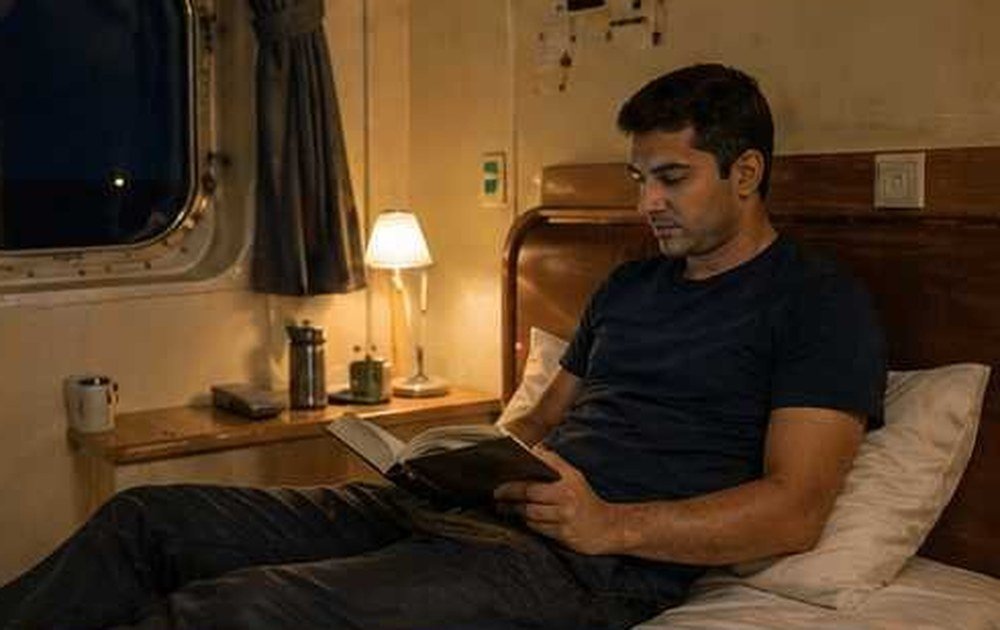
Your Child Wants to Join the Merchant Navy. Here Is What We Want Parents to Know
It usually starts at the dinner table. Your child puts down the roti and says, “Mummy, Papa, I want to join the merchant navy.”
Something in your chest goes tight before you have even answered.
You ask a sensible question about fees, maybe. You nod. But the thought in your head is much smaller and much harder to say out loud: months at sea? Who will look after my child out there?
If that is where you are tonight, this one is for you. We prepare students for merchant navy entrance exams here in Dehradun, and we are not going to sell you a white uniform. Some of what follows is reassuring. Some of it is not. You deserve both.
Your Fear Is Not Silly
Other parents worry about a hostel in Pune or a job in Bengaluru, places you can reach by train if something goes wrong. A ship does not work like that. There will be days when your child is in the middle of an ocean and you cannot get there, no matter how much money you have or who you know.
That is a real thing to feel. Please do not let anyone talk you out of it, and that includes a coaching institute. It is better to look at it properly.
The Months Away Are the Hard Part
Let us start with what usually hurts most. Officers often spend about 6 to 9 months at sea and 3 to 4 months at home in a year, though this changes with rank, ship and company. We have laid out the rank-wise picture in our guide on how many months officers stay at sea and at home.
A table cannot show you what that feels like. It means a Diwali with one plate less. A cousin’s wedding watched on a phone. A birthday call that cuts out halfway through because the signal has gone. Some years your child will miss the big days, and you will miss them too. There is no clever way around that.
There is another side to it, and we would be dishonest to leave it out. When sailors come home, they are home for weeks at a stretch. No office to rush to. Plenty of parents with office-going children never get a whole month with them. We will not pretend this evens everything out, but it is real, and it counts for something.
Will You Be Able to Talk to Them?
Most of the time, probably yes. Not always. This is one thing that has genuinely changed. Since December 2024, amendments to the Maritime Labour Convention have called for ships to provide social connectivity, which means ways to stay in touch with family such as email and messaging apps. How good that connection is still depends on the ship, the company and the flag. In the open ocean it can be patchy.
So make one small agreement before the first voyage: no reply for two days does not mean something is wrong. The ship may be far out at sea. There may be cargo work in port. Your child may simply be asleep after a long watch. Agreeing this now will save you a lot of 3 a.m. panic later.
Is It Safe?
We will not tell you nothing can go wrong. A ship means heavy machinery, rough weather and long hours, and some waters carry security risks too. Anyone who says otherwise is selling something.
What you can take some comfort in is how the work is organised. Students go through pre-sea training before they sail, and a cadet is not left in charge of anything alone. They learn under senior officers, as our guide to the duties of a deck cadet explains. For a fuller answer, read is the merchant navy safe. If you are the parent of a daughter, we have also written about whether girls can join the merchant navy.
The Loneliness Nobody Puts in the Brochure
If you asked us what to watch for, we would talk less about storms and more about a quiet cabin at 2 a.m.
In a Sailors’ Society and Yale survey of more than 1,000 seafarers, around 26% said they had felt down, depressed or hopeless on several days in the previous two weeks. Among those reporting symptoms of depression, 45% had not approached anyone for help. It is a survey and not a diagnosis, but that second number should stay with you.
Our children do not always tell us. “Sab theek hai, Mummy” may be the most common untruth in any Indian family, and it travels very well by satellite.
A few small things help:
- Ask specific questions. “All okay?” gets you “yes”. “What did you eat today?” and “Who were you on watch with?” get you an actual conversation.
- Let some calls be light. Not every call has to carry the worries from home. Sometimes they just need to hear the pressure cooker in the background.
- Keep one number ready. SeafarerHelp, run by the charity ISWAN, is a free and confidential 24-hour helpline for seafarers and for their families too. Save it now, while you do not need it.
Where Your Worry Can Actually Protect Them
Here is the part where a parent’s suspicion is a gift. The merchant navy has real opportunity in it, and real opportunity attracts people who prey on hopeful families. Before any money leaves your account:
- Check the institute. Here is how to verify a DG Shipping approved institute. It takes a little time and it is worth every minute.
- Check the recruiter. The DG Shipping website shows whether a recruitment agency’s licence (RPSL) is valid, invalid or temporarily blocked. Do this check yourself. Do not rely on a forwarded PDF.
- Do not pay for a job. A DG Shipping advisory warns seafarers against paying money for placement, handing a passport or CDC to unknown people, and accepting offers through WhatsApp or social media.
- Do the medical early. Read the medical test details before you pay big fees. Finding out about an eyesight problem after the money is spent is a heartbreak you can avoid.
Five Questions to Ask Your Child Before You Say Yes
- Why do you really want this? If the only answer is money, keep talking.
- Have you spoken to someone who is actually sailing? Someone with nothing to sell you, and ask them about their worst month.
- Can you live with missing things? Weddings, festivals, and perhaps one day something much harder than a festival. Have this conversation, even though nobody wants to.
- What will you do when it gets bad out there? Who will you call? Will you actually call?
- What is the plan if this does not work out? Exams, medicals and sponsorships do not always go your way, and it helps everyone to have a second road ready.
Then listen. Really listen. And if money is part of the conversation, as it should be, our merchant navy salary guide is an honest place to start, and this comparison with a corporate job may help too.
And If the Answer Is Yes
One day there will be an airport. You will tell them to eat on time for the fifth time, because it is the only sentence you can manage. They will roll their eyes. Then they will walk through the gate, and you will stand there a little longer than you need to.
Nothing we write can make that moment easy, and we would not trust any article that said it could. What you can do is make sure that when you let them go, you both know exactly what they are walking into.
If you would like to ask these questions in person, bring your child and bring your doubts. Talk to us at Officers Maritime Academy in Dehradun. The hard questions are the ones we would most like you to ask.
Frequently Asked Questions