Duties of a Deck Cadet Onboard Ship: Complete Beginner’s Guide (2026)
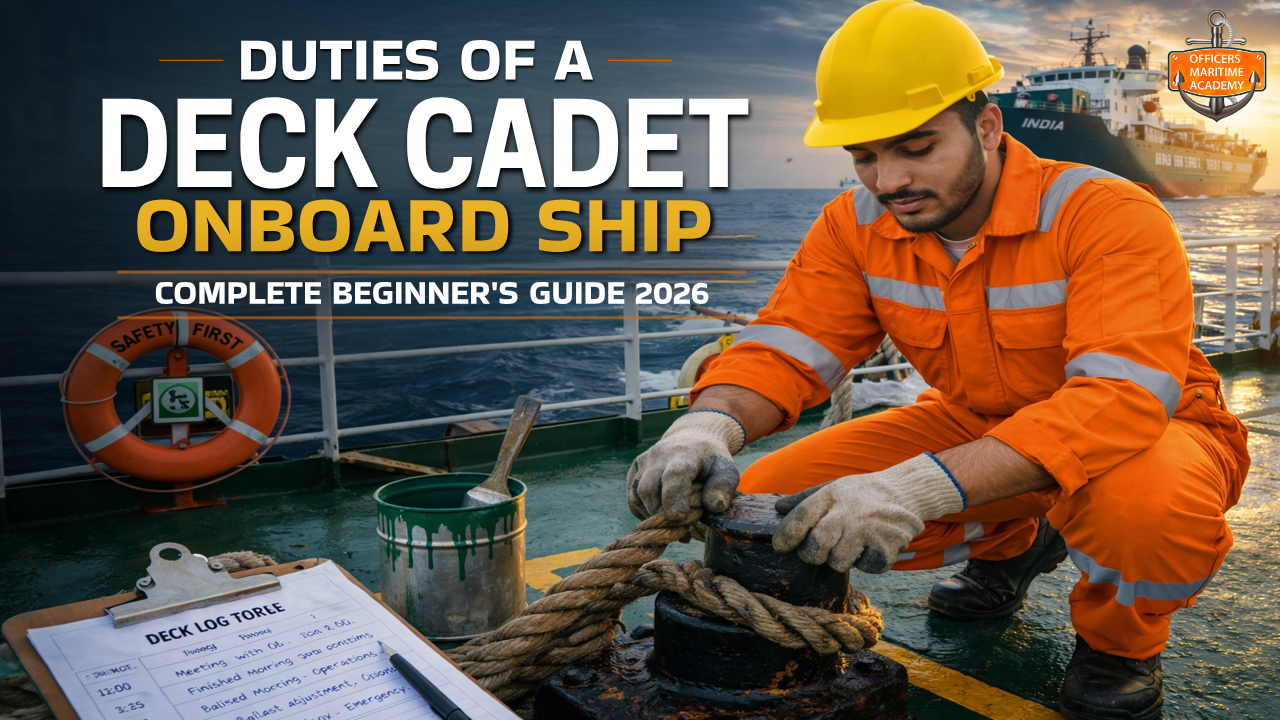
Stepping onto a merchant vessel for the first time after completing your B.Sc. Nautical Science or Diploma in Nautical Science (DNS) is a thrilling, yet intimidating, milestone. You are no longer in a classroom; you are in the real world of global shipping. But what exactly are the duties of a deck cadet onboard ship? For many beginners, the transition from maritime academy theory to the harsh, hands-on reality of the deck can be a shock. Officially, your working hours might be listed as 12 hours a day, but in reality, the daily tasks of a deck cadet on a ship frequently stretch to 14 or even 18 hours during busy port operations. As a leading platform for maritime aspirants, Merchant Navy Coach is here to decode this journey.
The Reality of the Duties of a Deck Cadet Onboard Ship
Before we dive into the specific tasks, it is crucial to understand why the duties of a deck cadet onboard ship are so diverse. You are essentially an officer-in-training. However, you do not start with authority; you start at the bottom to learn the foundation of every single job on the vessel.
You cannot effectively command a crew as a Chief Officer in the future if you do not personally know how hard it is to chip rust in the blazing sun or heave a heavy mooring line in the freezing rain. Your cadetship is a test of endurance, observation, and grit. Let’s break down exactly what your day-to-day operations will look like.
Navigation and Bridge Watchkeeping: Core Duties of a Deck Cadet Onboard Ship
Navigation is the beating heart of a vessel’s voyage. While you do not yet hold a valid Certificate of Competency (COC) to keep a bridge watch independently, deck cadet watchkeeping is where you learn the art and science of driving the ship.
- Learning the Ropes: The Chief Officer will use this time to test the theoretical knowledge you gained during your DNS or B.Sc. course.
- Core Tasks: Your navigation watch routines involve fixing the ship’s position using GPS and radar, practicing celestial navigation with a sextant, and visually identifying nearby vessels or navigational hazards.
- Lookout Duties: You will frequently act as the official lookout, scanning the horizon and reporting any anomalies to the Officer on Watch (OOW).
Tank Sounding and Stability Checks
One of the most physically demanding yet vital duties of a deck cadet onboard ship is taking tank soundings. “Sounding” is the maritime term for measuring the depth of fluid (ballast water, fresh water, or fuel) inside the ship’s various tanks.
- Why it Matters: The amount of fluid in the tanks directly dictates the ship’s stability, trim, and draft.
- The Routine: Generally, after your morning 0400–0800 watch, you will grab a sounding tape and physically walk the main deck to measure these tanks manually.
- Accuracy is Key: You must apply a sounding paste to the tape to clearly read the water or fuel marks, record the exact measurements, and update the daily sounding logbook for the Chief Officer.
Deck Maintenance: Chipping and Painting
A ship is made of steel, and the ocean is made of highly corrosive saltwater. Therefore, the battle against rust never ends. When listing the duties of a deck cadet onboard ship, deck maintenance tasks make up a massive portion of your daily routine.
- Chipping and Painting: You will spend countless hours using manual chipping hammers or pneumatic needle guns to strip away rust down to the bare, shiny steel. Afterward, you will apply protective primer and marine paint.
- Assisting the Pumpman: On tankers, you will often work alongside the Pumpman, overhauling heavy deck valves, greasing moving parts, and maintaining the complex web of pipelines.
- Future Preparation: Doing these cleaning and maintenance chores ensures that when you become a Chief Officer, you know exactly how long a job should take and how to execute it safely.
General Deck Work and Assisting the Bosun
The Bosun is the foreman of the deck crew. Assisting the Bosun is another essential part of the duties of a deck cadet onboard ship.
- The Groundwork: This might seem like menial labor at the start of your career, but it builds the framework of good seamanship.
- Rope Work: You will learn practical skills like rope splicing, tying essential knots, and securing loose gear before rough weather hits.
- Stenciling: On deck, painting clear safety signs, labeling pipes, and stenciling capacity marks is a primary and meticulous job assigned almost exclusively to cadets.
LSA and FFA Maintenance
Life Saving Appliances (LSA) and Fire Fighting Appliances (FFA) are your last lines of defense during an emergency at sea. Maintaining this equipment typically falls under the 3rd Officer’s jurisdiction, and as a cadet, you are their right-hand assistant.
- Safety Checks: The safety duties of a deck cadet onboard ship include inspecting lifeboats, checking the validity of distress flares (pyrotechnics), ensuring fire extinguishers are pressurized, and inspecting life rafts.
- Documentation: You will learn to note down expiry dates, log defect reports, and draft emails to the company to order replacement safety gear.
- Exam Prep: A massive chunk of your 2nd Officer CoC oral exams will focus on SOLAS (Safety of Life at Sea) regulations regarding LSA/FFA. Getting hands-on experience now is the best way to study.
Paperwork and Logbook Entries
The shipping industry runs on documentation. A significant part of the duties of a deck cadet onboard ship involves mastering maritime paperwork.
- Administrative Support: You will assist the Chief Officer in maintaining official records. This includes making photocopies of crew lists, updating the garbage management log, and filling out the daily work planner.
- Logbook Entries: You are often tasked with writing the noon position reports, recording weather data (barometric pressure, wind speed, sea state), and ensuring the deck logbook is neat, accurate, and up-to-date.
Port Work and Cargo Operations
When the ship arrives at a port, the pace of work accelerates drastically. During port stays, the duties of a deck cadet onboard ship shift heavily toward monitoring cargo operations.
- Paperwork at Port: You will assist the 3rd Officer in preparing arrival documents, crew declarations, and bonded store lists for customs and immigration officials.
- Monitoring Cargo: Whether loading containers, pumping oil, or pouring bulk grain, you must maintain a continuous port watch. You will note the precise start and stop times of loading operations.
- Communication: You will be stationed on the deck with a portable VHF walkie-talkie, keeping a sharp eye on tank levels, checking draft marks over the side of the ship, and relaying continuous feedback to the duty officer in the cargo control room.
Berthing and Unberthing Operations
Bringing a massive commercial vessel safely alongside a concrete pier (berthing) or pulling away to head to sea (unberthing) requires immense coordination. Executing berthing and unberthing safely are critical duties of a deck cadet onboard ship.
- Deck Stations: The entire deck crew is divided into forward (bow) and aft (stern) stations. A cadet usually starts out performing the heavy physical work of a rating at these stations.
- Preparations: Your responsibilities include clearing the deck, testing the winches, preparing heaving lines, and ensuring all communication equipment is functioning before the pilot boards the vessel.
Mooring Operations and Line Handling
Directly tied to berthing are the mooring duties of a deck cadet onboard ship. This involves managing the heavy ropes and steel wires that hold the ship to the dock.
- Handling Lines: You will assist the crew in sending mooring lines ashore and heaving them tight using powerful winches.
- Tide Management: Ships rise and fall with the tide. A critical port duty is constantly monitoring and adjusting (slacking or tightening) the mooring ropes to ensure the ship remains securely alongside without snapping a line under extreme tension.
- Future Command: When you earn your promotion to 3rd Officer, you will be the one in charge of the entire forward or aft mooring station, making this hands-on cadet experience invaluable.
Project Work and the SSTP
Amidst all the physical labor, the duties of a deck cadet onboard ship also include a heavy academic component. You are still a student completing your training.
- Structured Shipboard Training Programme (SSTP): You are required to maintain a detailed Training Record Book (TRB). Every time you learn a new skill—from deploying a pilot ladder to plotting a course—you must document it and have a senior officer sign off on your competence.
- Distance Learning: The Chief Officer will usually grant you specific free time to complete your mandatory distance learning projects and assignments, which must be submitted to your maritime academy.
Golden Qualities Every Cadet Must Possess
Beyond executing the 10 core tasks listed above, surviving and thriving as a deck cadet requires a specific mindset. The ocean is unforgiving, and the hierarchy on a ship is strict. To succeed, you need these three traits:
- An Insatiable Eagerness to Learn: If you show genuine curiosity and a willingness to work hard, senior officers will go out of their way to teach you the secrets of navigation and seamanship. If you are lazy, they will simply let you chip rust for six months.
- Proactive Initiative: Do not wait to be told what to do. If you see a dirty deck, sweep it. If you see a rusted pipe, grab a chipping hammer. Taking the initiative, no matter how small or dirty the job, proves your work ethic to the crew.
- Unbreakable Integrity (Never Lie): Mistakes happen. You might accidentally paint over a vital stenciled mark or misread a sounding tape. Never cover it up. Always go directly to your Chief Officer and own your mistake. You are on the ship with one overarching goal: earning the absolute trust of your seniors and your juniors. Safety at sea relies entirely on honesty.
Conclusion: Launch Your Merchant Navy Career
Ultimately, the duties of a deck cadet onboard ship are exhausting, vast, and infinitely rewarding. You are the backbone of the deck crew, the extra eyes on the navigational bridge, and the future leader of the vessel. Yes, you will work 14-hour days, your hands will get dirty, and you will miss home. But you will also learn to navigate by the stars, manage millions of dollars of cargo, and build a resilient character that few other professions can offer.
If you are ready to take the leap and want to know exactly how to clear your IMU-CET exams, secure a top sponsorship, and step onboard your first vessel fully prepared, Merchant Navy Coach is your ultimate partner.
Duties of a Deck Cadet Onboard Ship: Complete Beginner’s Guide (2026)
Duties of a Deck Cadet Onboard Ship: Complete Beginner’s Guide (2026) Stepping onto a merchant vessel for the first time after completing your B.Sc. Nautical