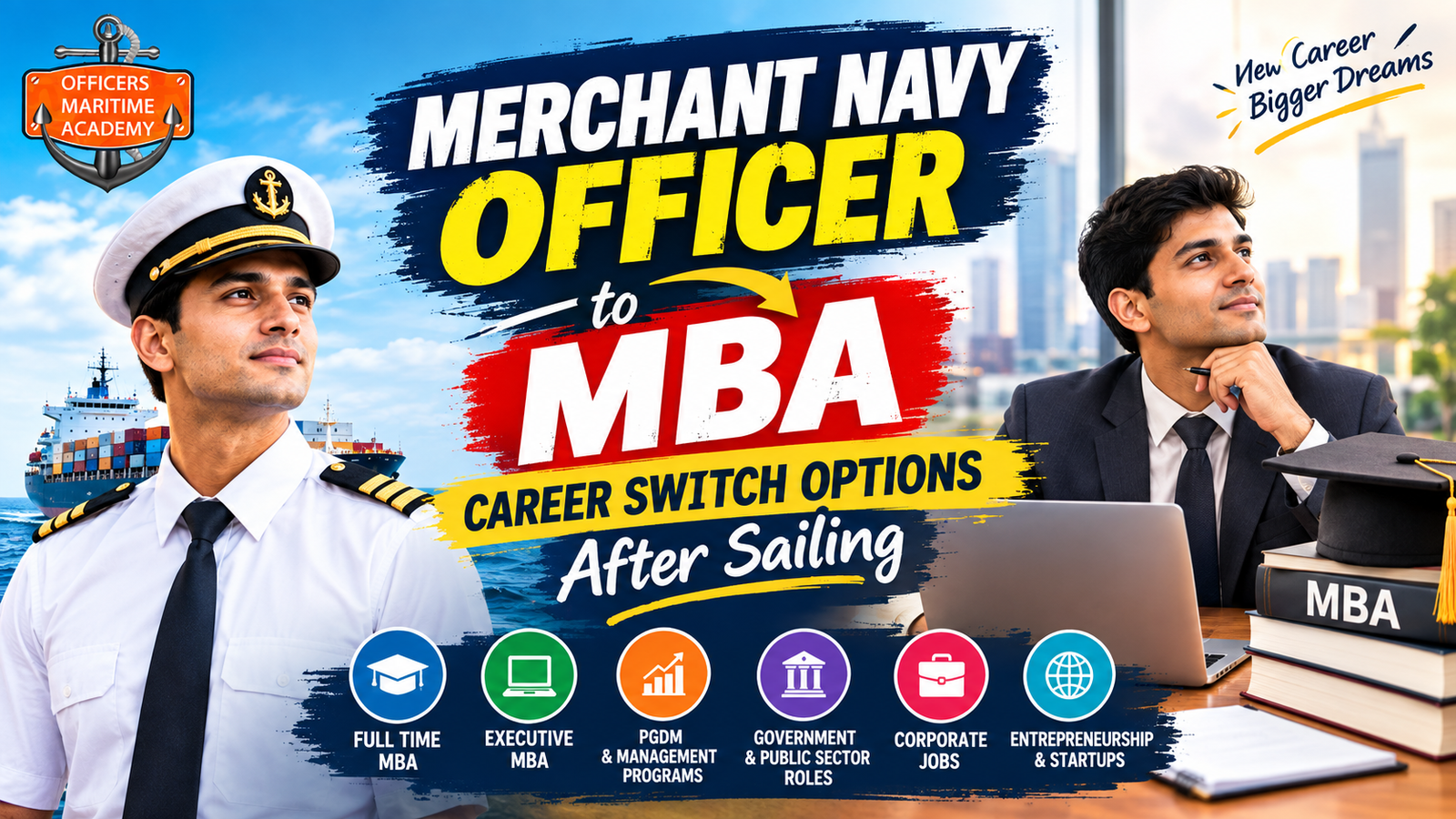
Merchant Navy Officer to MBA: Career Switch Options After Sailing
Every sailor eventually asks the same question while staring at the horizon during a long watch: “How long do I want to keep sailing?” For thousands of deck and engine officers in India, the answer isn’t about disliking the sea — it’s about planning what comes next. That’s exactly why the Merchant Navy Officer to MBA route has become one of the most searched career transitions among mariners with three to ten years of sea experience.
This guide breaks down why this switch makes sense, which MBA specializations suit ex-officers best, the entrance exams you’ll need to clear, and what your career and salary could look like once you’re ashore for good.
Why Merchant Navy Officers Consider an MBA
Life at sea is demanding — long contracts, months away from family, and a career clock that eventually runs into medical fitness limits, promotion bottlenecks, or simply personal priorities like marriage and children. Many officers who cleared their Merchant Navy after 12th entrance and sailed as cadets, Second Officers, or Chief Engineers start thinking about a shore-based second innings around their late twenties or early thirties.
An MBA is attractive for three practical reasons:
- It converts sea-going experience into a management credential that shore-based companies actually value.
- It shortens the learning curve for functions like operations, supply chain, HR, and finance, where technical shipboard knowledge already gives officers an edge.
- It opens roles outside shipping too — banking, consulting, logistics, and general management — in case an officer wants a complete industry change.
This career switch isn’t a rejection of your sailing years; it’s a way to monetize them differently.
Merchant Navy Officer to MBA: Is It the Right Move?
Before applying to business schools, it helps to be honest about your motivation. This switch tends to work well when an officer:
- Has completed at least 2–4 years of sea service and holds a valid Continuous Discharge Certificate (CDC) and relevant Certificate of Competency.
- Wants a predictable, shore-based lifestyle after years of rotational contracts.
- Is genuinely interested in business functions — not just looking to “escape” a tough sea job without a real plan.
- Is willing to study for a competitive entrance exam while balancing watchkeeping duties or study leave.
If these apply to you, this transition can be one of the most rewarding career pivots in the maritime industry — provided you choose the right specialization and institute.
Best MBA Specializations for Ex-Merchant Navy Officers
Not every MBA stream suits a former mariner equally. Based on what recruiters actually look for, these specializations align best with a sailing background:
- Operations Management
Shipboard officers already manage cargo operations, watch schedules, and crew logistics — this maps almost directly onto plant and operations roles ashore.
- Supply Chain & Logistics Management
Given firsthand exposure to ports, cargo documentation, and international trade routes, this is the most natural specialization for a sailing officer targeting shipping, freight forwarding, or 3PL companies after business school.
- Shipping & Port Management
Several Indian B-schools now offer dedicated maritime management programs, letting officers stay within the industry while moving from ship to shore roles like fleet management, chartering, or port operations.
- General Management / PGDM
For officers who want to explore beyond shipping entirely — into FMCG, consulting, or banking — a broad general management degree keeps options open.
- Human Resources
Officers who’ve led and mentored junior crew on long voyages often find HR and people-management roles a natural extension of their leadership experience.
Top MBA Entrance Exams and Eligibility
To make this switch successfully, you’ll typically need to clear one of these standardized entrance exams:
| Exam | Conducted By | Best Suited For |
|---|
| CAT (Common Admission Test) | IIMs | IIMs and top-tier Indian B-schools |
| XAT | XLRI Jamshedpur | General management, HR |
| CMAT | National Testing Agency | Government-approved MBA colleges |
| GMAT | GMAC | Shipping & maritime MBAs abroad, executive MBAs |
| SNAP / NMAT | Symbiosis / NMIMS | Working professionals, flexible formats |
Most exams don’t require a business background, which works in favor of officers with a nautical science or marine engineering degree — as long as verbal reasoning and quantitative aptitude are practiced well in advance. Quant sections, in particular, tend to favor candidates from a technical or engineering background, giving marine engineers a natural head start over non-technical applicants. Officers who’ve already been through rigorous exam prep, such as IMU-CET coaching, often find the discipline required for MBA entrance prep familiar territory.
For official exam details, aspirants can refer to the Common Admission Test (CAT) official website and the Graduate Management Admission Council (GMAT) for globally recognized options.
Career Options After a Merchant Navy Officer to MBA Switch
Once the degree is done, here’s where ex-officers typically land. Placement outcomes vary by institute and specialization, but shipping-adjacent industries tend to actively seek out candidates with genuine sea-going experience, since it shortens onboarding time significantly:
- Ship Management Companies — fleet operations, technical superintendent support roles, crewing management, and marine HR.
- Chartering & Broking Firms — using onboard cargo and voyage knowledge to negotiate freight contracts.
- Port and Terminal Operations — managing vessel scheduling, cargo handling, and stevedoring operations ashore.
- Marine Insurance & P&I Clubs — claims handling and risk assessment benefit hugely from real sailing experience.
- Logistics and Supply Chain Companies — 3PL, freight forwarding, and import-export operations.
- Corporate Roles Outside Shipping — banking, consulting, and general management, especially after a general MBA.
This is worth comparing against staying at sea, since both paths have very different trajectories, which brings us to the comparison below.
Sailing Career vs MBA Career: A Side-by-Side Comparison
| Factor | Continuing at Sea | Switching to a Shore-Based MBA |
|---|
| Time to promotion | Structured, rank-based (2nd Officer to Captain) | Depends on company hierarchy, generally faster on shore |
| Work-life balance | Contract-based, months away from family | Regular working hours, home every day |
| Earning potential (early years) | High, tax-free income while sailing | Lower during MBA years, rises post-placement |
| Long-term ceiling | Capped by rank and fleet size | Higher ceiling in senior management and leadership roles |
| Networking & exposure | Limited to onboard crew and company office | Wide industry exposure through B-school placements |
| Physical demands | High — sea time, medical fitness required | Low — desk-based, sustainable long-term |
| Career flexibility | Mostly shipping-industry specific | Opens shipping, logistics, finance, and consulting sectors |
Neither path is objectively “better” — it depends on what stage of life an officer is in and what they want from the next 15–20 years of their career. Some officers alternate between the two, sailing for a few more contracts to build savings before joining a full-time program, while others move ashore the moment they clear their entrance exam. Family circumstances often tip the scale too — officers starting families, or those with ageing parents at home, frequently prioritize the predictability of shore life over the tax-free earnings of a sea contract. For a broader look at this decision, our detailed breakdown on Merchant Navy vs Corporate Job covers the same trade-offs from a wider angle.
Skills Merchant Navy Officers Bring to B-Schools
Admission committees and recruiters consistently rate ex-mariners highly because of skills that are hard to teach in a classroom:
- Crisis management — handling emergencies at sea builds calm, structured decision-making under pressure.
- Cross-cultural teamwork — multinational crews mean officers are used to managing diverse teams.
- Discipline and punctuality — watchkeeping schedules instill a work ethic that shows up clearly in B-school performance.
- Global exposure — having worked across ports and countries gives a practical understanding of international trade that classroom case studies can’t fully replicate.
- Risk assessment — officers are trained to think several steps ahead when it comes to weather, machinery, and cargo safety, a mindset that translates directly into strategic business decision-making.
This is precisely why an ex-mariner applying to business school often stands out in interview panels compared to candidates coming straight from undergraduate degrees. Admission essays that describe real onboard incidents — a machinery breakdown handled mid-voyage, or a cargo emergency resolved under time pressure — tend to leave a stronger impression than theoretical case studies ever could.
How to Plan the Transition While Still Sailing
- Start exam prep during your sea contract. Use off-duty hours to build a habit of daily quant and verbal practice.
- Choose your specialization before applying. Operations, supply chain, or shipping management keep your maritime background relevant.
- Keep your documents ready — CDC, COC, sea service records, and academic transcripts are needed for both entrance applications and work experience verification.
- Time your exit properly. Many officers complete one final contract, bank sea time for a senior COC if needed, then sign off to join a full-time MBA program.
- Talk to seniors who’ve already made the switch. Real accounts of their journey from ship to B-school are far more useful than generic career advice.
If you’re still early in your maritime journey and evaluating entry options, our guides on B.Sc Nautical Science and Marine Engineering courses are a good starting point before you even think about the MBA stage.
Final Thoughts
The Merchant Navy Officer to MBA path isn’t about giving up on the sea — it’s about deciding how you want the next chapter of your career to look. Whether you choose to stay close to shipping through a maritime MBA or branch out into a completely new industry, the discipline, leadership, and global exposure you’ve gained on board will stay with you wherever you go next.
If you’re still deciding on your entry point into the Merchant Navy or want guidance on sponsorship and entrance exams before you even start sailing, explore our IMU-CET & sponsorship coaching programs or get in touch with our counselors for personalized guidance.
FAQ