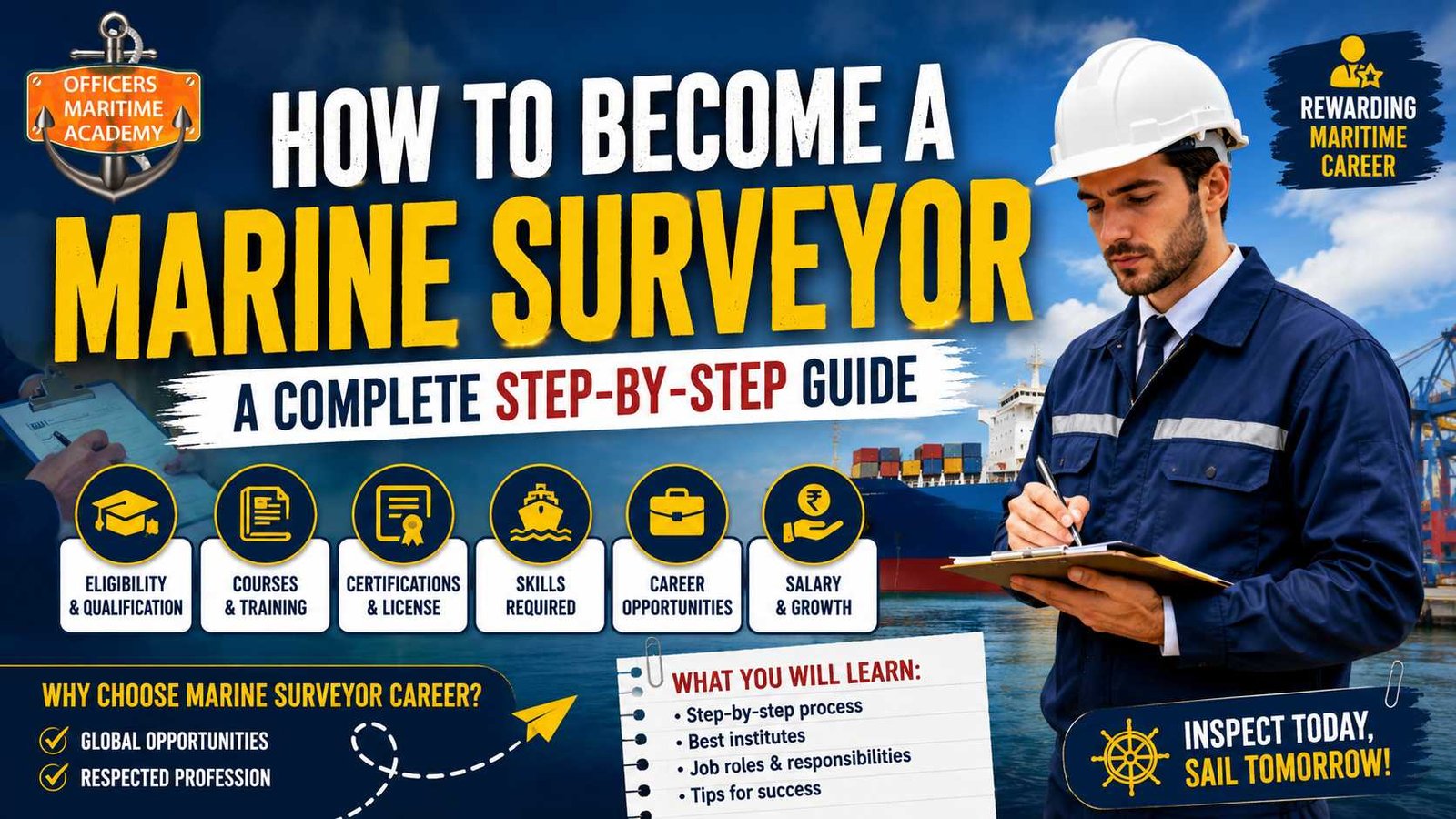
How to Become a Marine Surveyor: A Complete Step-by-Step Guide
Spending years at sea as a deck officer gives you something no textbook can teach — real, hands-on knowledge of how ships work, what can go wrong, and what it takes to keep a vessel safe and compliant. At some point, many experienced mariners start thinking about coming ashore. And one of the most natural, well-paying, and respected career paths waiting for them is marine surveying.
But where do you actually begin? What does the role involve? What qualifications, certifications, and steps do you need to follow?
At Merchant Navy Coach, we work with deck officers and maritime professionals every day to help them plan smart career transitions. This is our complete, practical guide on how to become a marine surveyor — written in plain English, structured around the real questions people ask, and based on what actually works in today’s maritime job market.
What Exactly Is a Marine Surveyor?
A marine surveyor is a qualified professional who inspects ships, vessels, cargo, and marine equipment — then produces authoritative reports on what they find. They work as independent experts, and their findings are trusted by shipowners, banks, insurers, port authorities, and courts.
What makes this role so well-suited for deck officers is that the job is fundamentally about applying maritime knowledge in a structured, analytical way. You are not learning the sea from scratch — you are using everything you already know to evaluate it professionally and objectively.
Marine surveyors are employed by classification societies, P&I clubs, marine insurance companies, and independent surveying firms. Many also build their own freelance practice and work as independent contractors on a project-by-project basis.
What Are the Different Types of Marine Surveyors?
Understanding the specialisations available is an important early step when planning how to become a marine surveyor. The field is broader than most people realise.
Cargo Surveyor Responsible for verifying that cargo is loaded, secured, and transported according to regulations and industry standards. This role requires a strong understanding of cargo operations, stowage plans, and applicable international codes. This is one of the most common entry points for ex-deck officers.
Hull and Condition Surveyor Focuses on the structural condition of a vessel — checking the hull plating, frames, welds, and overall seaworthiness. Requires knowledge of ship construction and an eye for spotting deterioration, corrosion, and damage.
Marine Warranty Surveyor (MWS) This is one of the more specialised — and highly paid — roles in the field. Marine warranty surveyors provide independent verification for high-risk or high-value marine operations such as heavy lifts, offshore installations, and towage. They ensure all procedures and equipment meet contractual and industry requirements before operations begin.
Classification Society Surveyor Represents a classification society such as Lloyd’s Register, Bureau Veritas, or DNV. These surveyors inspect vessels during construction and throughout their working life to ensure compliance with classification rules. This is a stable, well-structured career path with clear progression.
Owner’s Side Inspector Represents the interests of a shipowner during drydock, repairs, or new construction. Ensures that work is done correctly, on time, and to the agreed standard — acting as the technical eyes and ears of the owner on the ground.
Marine Cargo and P&I Club Surveyor Works on behalf of Protection & Indemnity (P&I) clubs to investigate incidents, cargo claims, and damage disputes. Requires strong knowledge of maritime law alongside technical surveying skills.
Who Is Eligible to Become a Marine Surveyor?
Route 1 — Deck Officers and Master Mariners (Strongest Route)
This is the most direct and most respected pathway into marine surveying. If you hold a Class 1 or Class 2 Certificate of Competency (COC) as a deck officer — or have served as Chief Officer or Master — you meet the core eligibility requirement that most classification societies, P&I clubs, and surveying firms look for.
Minimum eligibility under this route typically includes:
- Valid COC at Officer of the Watch (OOW) level or above
- Minimum 3–5 years of sea service as a deck officer (more is better)
- Familiarity with SOLAS, MARPOL, ISM Code, and STCW conventions
Route 2 — Marine Engineers
Marine engineers are equally well-positioned, particularly for machinery surveys, drydock inspections, and technical condition assessments. A Chief Engineer or Second Engineer certificate with solid shipboard experience is an excellent foundation.
Route 3 — Naval Architects and Marine Technology Graduates
Fresh graduates from naval architecture or marine engineering programmes can enter the field, but they will need additional supervised field experience before practising independently. This route usually requires 2–3 years of yard or shipboard exposure before formal surveying training begins.
Route 4 — Other Maritime Professionals
Port captains, harbour masters, maritime safety officers, and professionals with experience in flag state administration or port state control (PSC) are also well-suited to transitioning into surveying, particularly statutory and compliance-focused roles.
Age and Physical Requirements: There is no strict upper age limit for marine surveyors. However, the role does require physical fitness — surveyors regularly board vessels, descend into tanks, climb gangways, and inspect confined spaces. Good health and reasonable physical mobility are practical necessities.
Courses and Training for Marine Surveyors
The right training depends on your background and which type of surveying you are targeting. Choosing the right course is a key part of planning how to become a marine surveyor effectively — the wrong course for your background wastes time and money. Here is a full picture of the courses and qualifications that matter most:
1. IIMS Foundation and Specialist Courses
The International Institute of Marine Surveying (IIMS) is the most widely recognised professional body for marine surveyors globally. They offer structured programmes covering:
- Foundation Certificate in Marine Surveying — ideal starting point for maritime professionals entering the field
- Hull and Machinery Survey — covers inspection techniques, corrosion assessment, and structural evaluation
- Cargo Surveying Certificate — covers commodity-specific cargo inspection, sampling, and claim reporting
- Marine Warranty Surveying — for those targeting high-value offshore and marine operations
All IIMS courses are available in both classroom and distance learning formats, making them accessible for mariners who are still sailing part-time while planning their transition.
2. SAMS Examination and Accreditation
The Society of Accredited Marine Surveyors (SAMS) offers a recognised accreditation pathway particularly strong in the North American recreational and small vessel market. Eligibility requires 5 years of verifiable vessel inspection experience plus a written examination and peer-reviewed sample reports.
3. NAMS Certified Marine Surveyor (CMS) Programme
The National Association of Marine Surveyors (NAMS) offers the CMS designation — one of the most recognised credentials for surveyors working in the US market. It involves examination, documented experience, and continuing education requirements.
4. Lloyd’s Maritime Academy — Cargo Handling and Stowage
An excellent course for those targeting cargo surveying roles. Covers international cargo regulations, stowage planning, dangerous goods handling, and damage claim procedures.
5. Classification Society Training Programmes
Lloyd’s Register, Bureau Veritas, DNV, and other classification societies run their own internal training programmes for newly recruited surveyors. These are typically offered to professionals who join them as employees, providing structured on-the-job learning alongside formal classroom modules.
6. CMRP — Certified Marine Risk Professional
Particularly valuable for marine warranty surveyors and P&I club surveyors. Covers risk identification, risk quantification, and risk management within a marine operational context.
7. PMP — Project Management Professional
Useful for senior surveyors managing complex marine projects involving multiple contractors and tight timelines. Not maritime-specific, but widely respected and genuinely applicable to advanced marine warranty work.
Typical Training Timeline
Most deck officers completing a planned transition into marine surveying — including sea service, formal courses, and supervised field experience — are ready to practice independently within 12 to 24 months of beginning their shore-based transition.
How to Become a Marine Surveyor: The Step-by-Step Path
Step 1 — Build Your Sea Service Foundation
The strongest foundation for a marine surveying career is substantial sea time as a deck officer. If you currently hold a Chief Officer or Master Mariner certificate, you are already in the best possible position. Your knowledge of stability, cargo operations, safety management systems, and SOLAS compliance is exactly what surveying employers and clients look for.
At Merchant Navy Coach, we consistently advise mariners to complete their sea service thoroughly before looking to transition. Surveyors who have actually held command or senior deck positions carry significantly more credibility with clients and employers than those who come through purely academic routes.
Step 2 — Choose Your Specialisation
Before looking for courses or jobs, decide which area of marine surveying interests you most. Your sea background will naturally suit certain roles — for example, deck officers tend to move well into cargo surveying, hull surveying, or marine warranty surveying because of their direct operational experience in these areas.
This matters because your training, the certifications you pursue, and the firms you approach for work should all align with your chosen specialisation.
Step 3 — Complete a Recognised Marine Surveying Course
Formal training is important both for your own confidence and for your professional credibility. The good news is there are strong, well-recognised programmes available.
IIMS Courses (International Institute of Marine Surveying) The IIMS offers a range of marine surveying certifications covering cargo surveying, hull and condition surveys, and marine warranty surveying. Their programmes are built specifically for maritime professionals making the transition to surveying and are recognised internationally. This is usually the first formal training step for deck officers entering the field.
CMRP — Certified Marine Risk Professional For those targeting marine warranty surveying or P&I club work, a certification in marine risk management adds significant professional depth. The CMRP qualification equips you to identify, assess, and manage the kinds of complex operational risks that come with high-value marine projects.
Lloyd’s Maritime Academy — Cargo Handling and Stowage If cargo surveying is your target, this programme from Lloyd’s Maritime Academy gives you a thorough grounding in cargo handling best practices, safety regulations, and compliance requirements — all of which are directly tested in day-to-day cargo survey work.
PMP — Project Management Professional This might seem like an unusual choice for a marine surveyor, but senior surveyors and marine warranty surveyors regularly oversee complex, multi-party projects. PMP certification gives you a structured approach to managing timelines, stakeholders, and deliverables — skills that directly improve your effectiveness and your earning potential in more senior roles.
Step 4 — Gain Supervised Field Experience
Classroom knowledge and sea time together create a surveyor. But you also need supervised field experience — actually watching and assisting qualified surveyors conduct real inspections before doing them independently.
Look for opportunities to shadow surveyors during drydock inspections, cargo surveys, or pre-purchase boat surveys. Some classification societies and marine surveying firms offer formal training pathways or graduate schemes for professionals transitioning from sea. Approach firms directly, explain your background, and express interest in mentorship. Most experienced surveyors remember being new to the role and are willing to guide the right candidate.
Step 5 — Build a Professional Report Portfolio
Surveying is ultimately a reporting profession. Your survey report is your product — it is what the client pays for, and it is what insurers, banks, and lawyers rely on. Practising clear, structured, unambiguous technical writing is non-negotiable.
Start building a portfolio of well-written sample reports during your training and mentorship phase. Whether you are producing vessel condition reports after hull inspections or documenting findings from marine cargo surveying assignments, every report you write sharpens your skills and demonstrates your professional competence. When you apply for professional membership with bodies like IIMS, your ability to produce professional-standard reports is assessed as part of the process.
Step 6 — Apply for Professional Membership
Recognised professional membership gives you immediate credibility in the market and makes you findable by clients and employers who actively search directories for qualified surveyors.
Key bodies to consider:
- IIMS (International Institute of Marine Surveying) — globally recognised, strong across commercial and cargo surveying
- SAMS (Society of Accredited Marine Surveyors) — particularly relevant in North American markets for recreational and small vessel surveys
- NAMS (National Association of Marine Surveyors) — offers the Certified Marine Surveyor (CMS) designation, widely recognised in the US
Getting onto an accredited marine surveyor list through any of these bodies is a significant step in establishing your practice.
Step 7 — Find Your First Role or Build Your Practice
Once you have your training and credentials in place, there are two main directions to consider.
Joining a Company Working as an employed surveyor with a classification society, P&I club, marine insurance firm, or independent surveying company gives you structured career progression, consistent income, and exposure to a wide variety of survey types early in your career. Entry-level marine surveyor jobs at this stage may start at $30,000–$40,000 annually, growing significantly with experience and specialisation. Senior or managerial surveyors in company roles can earn $80,000 or more per year.
When searching for employed positions, the most effective platforms are dedicated maritime job portals — MarineLink, Sea Career, and Martide all regularly list marine surveying positions. General portals like LinkedIn and Indeed are also worth monitoring with filtered searches for maritime roles.
Going Freelance For those who prefer independence and variety, the freelance route offers strong earning potential and global reach. Experienced freelance marine surveyors typically set daily rates between $600 and $800, with senior specialists and marine warranty surveyors often charging significantly more per engagement. Annual earnings for established freelancers can comfortably reach six figures.
Building a freelance practice requires strong networking, professional directory listings, and relationship-building with marine insurers, yacht brokers, and port agents who regularly refer survey work.
What Skills Do You Need to Succeed as a Marine Surveyor?
The good news for deck officers is that most of the core skills required are already part of your professional DNA.
Technical and navigational knowledge — your understanding of vessel operations, stability, cargo systems, and maritime regulations is the bedrock of credible surveying work.
Attention to detail — surveyors are hired to catch what others miss. A minor defect in a hull weld or an overlooked cargo discrepancy can have serious legal and financial consequences.
Clear, precise report writing — your written report is your professional reputation. Vague or poorly structured reports damage your credibility; clear, well-evidenced reports build it.
Communication and client management — you will regularly explain complex technical findings to clients who are not maritime professionals. The ability to translate technical language into plain terms is a major professional advantage.
Regulatory knowledge — deep familiarity with SOLAS, MARPOL, ISM Code, Load Line Conventions, and relevant classification society rules is essential for most surveying roles.
Risk assessment and problem-solving — particularly important for marine warranty surveying, where you are often the last expert check before a complex and potentially dangerous marine operation begins.
How Much Does a Marine Surveyor Earn?
Marine surveyor salary is one of the most searched topics for anyone researching this career. Here is a realistic picture based on current market data:
- Entry-level employed surveyors: $30,000–$40,000 per year
- Experienced company surveyors: $60,000–$80,000+ per year, rising further in managerial roles
- Freelance surveyors (daily rate): $600–$800 per day, varying with specialisation and client type
- Senior marine warranty surveyors: Among the highest earners in the field, often exceeding $100,000+ annually
The marine surveyor market demand remains strong globally. Growing maritime trade, increasing regulatory complexity, the expansion of offshore energy projects, and a steady supply of vessel transactions all drive consistent demand for qualified, experienced surveyors. The job outlook for the profession is positive well into the coming decade.
How Can Merchant Navy Coach Help You Make This Transition?
At Merchant Navy Coach, we help maritime professionals do exactly what this blog describes — turn sea experience into a rewarding shore-based career.
We provide personalised guidance on:
- Which marine surveying specialisation fits your background and goals
- Which courses and certifications to pursue and in what order
- How to write your first professional survey reports
- How to approach classification societies, P&I clubs, and surveying firms for mentorship or employment
- How to build a freelance marine surveyor practice from scratch
- How to create a strong maritime LinkedIn profile that attracts the right employers
Whether you are a Chief Officer with 10 years at sea wondering what comes next, or a newly certificated Master looking at long-term shore options, we will help you build a plan that gets you there.
Final Thoughts
Marine surveying is one of the most intellectually rewarding and financially solid careers available to experienced maritime professionals. It honours your sea knowledge, keeps you connected to the world of ships and maritime commerce, and offers real career choice — the stability of an employed role or the freedom of independent practice.
Understanding how to become a marine surveyor is the first step. Taking that knowledge and building a structured plan around your specific background and goals is where Merchant Navy Coach comes in.
To book a one-on-one career consultation.
📞 Contact us today
🌐 Visit: merchantnavycoach.com
Merchant Navy Officer to MBA: Career Switch Options After Sailing
Merchant Navy Officer to MBA: Career Switch Options After Sailing Every sailor eventually asks the same question while staring at the horizon during a long watch: “How long do I
IMU CET General Knowledge & Aptitude Syllabus 2026
IMU CET General Knowledge & Aptitude Syllabus 2026 Most IMU CET aspirants spend 90% of their study hours on Physics, Chemistry, and Maths — and completely ignore the 40 marks
IMU CET Maths Syllabus & Important Topics 2026
IMU CET Maths Syllabus & Important Topics 2026 If you are preparing for the Merchant Navy entrance exam, you have probably already gone through the Physics and Chemistry portions. But

Top Shipping Companies Offering Sponsorship in India
Top Shipping Companies Offering Sponsorship in India 2026 If you have decided to join the Merchant Navy, you have probably heard seniors talk about “sponsorship.” It is one of the

Merchant Navy vs Corporate Job: Which Career Should You Choose?
Merchant Navy vs Corporate Job: Which Career Should You Choose? Every year, thousands of students face the same big question after 12th or graduation — should I go for a
Why Uttarakhand Is Emerging as a Merchant Navy Education Hub for Students Across India
Why Uttarakhand Is Emerging as a Merchant Navy Education Hub for Students Across India For decades, students dreaming of a career at sea looked toward Mumbai, Chennai, or Kochi for