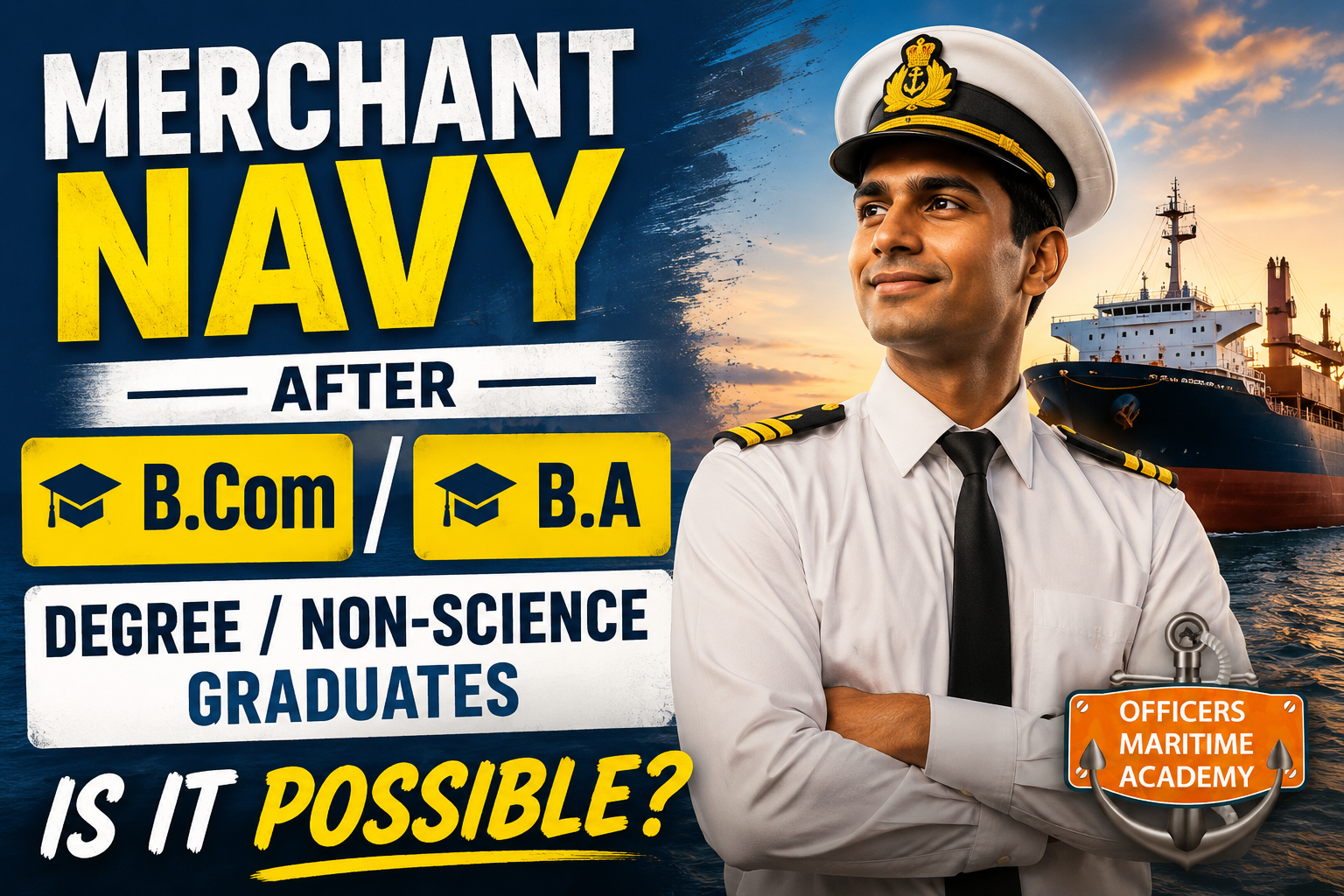
Merchant Navy After B.Com, B.A Degree & Non-Science Graduates: Is It Possible?
Introduction
If you’re holding a Bachelor of Commerce degree, a Bachelor of Arts degree, or any other non-science qualification and dreaming of a maritime career, you’ve probably heard conflicting information. Some say the Merchant Navy is only for science graduates. Others swear it’s possible without a science background.
The truth? You can absolutely join the Merchant Navy after B.Com, B.A degree & Non-Science Graduate. But there’s a catch—your pathway is different from science graduates, and understanding these alternative routes is crucial for planning your maritime career successfully.
I see hundreds of non-science graduates every year at Merchant Navy Coach who are eager to join the Merchant Navy but don’t know where to start.
The Short Answer: Yes, You Can Join the Merchant Navy With B.Com or B.A
Unlike popular belief, the Merchant Navy doesn’t exclusively belong to science graduates. The industry desperately needs professionals from diverse educational backgrounds because shipping companies require management, commercial operations, technical expertise, and administrative support—not just deck officers and marine engineers.
Here are the facts:
- B.Com graduates can join through the GME Course (Graduate Marine Engineering), ETO Course (Electro-Technical Officer), or pursue merchant navy management roles
- B.A graduates can access the same pathways as B.Com graduates
- Non-science graduates from any discipline can enter the maritime industry through specialized post-graduate training programs
- The Indian maritime sector actively recruits graduates from non-traditional academic backgrounds
The key is understanding which courses and pathways are specifically designed for you.
Understanding Your Position: Commerce vs. Science Graduates
Key Differences in Entry Routes
| Criteria |
Science Graduates (Physics, Chemistry, Math) |
Commerce/Arts Graduates |
| Direct Entry |
Yes, to nautical science courses |
No direct deck officer entry |
| Alternative Routes |
All available |
GME, ETO, Management roles |
| Age Flexibility |
Strict age limits (17-25 for DNS) |
More flexibility (varies by course) |
| Entry-Level Role |
Deck Cadet, Engine Cadet |
Graduate Officer Cadet |
| Eligibility for GME |
Yes |
Yes ✅ |
| Eligibility for ETO |
Yes (if eligible background) |
Yes ✅ |
| Time to Captain |
~15-18 years |
~17-20 years |
| Career Progression |
Officer → Superintending Officer → Captain |
Officer → Management → Captain |
As you can see, while the timeline differs slightly, the end destination is the same.
Best Pathways for B.Com / Arts / Non-Science Graduates
1. Graduate Marine Engineering (GME) Course – The Most Popular Route
What is GME?
The Graduate Marine Engineering (GME) course is a one-year Pre-sea Training program specifically designed for graduates who have completed their Bachelor’s degree in any engineering discipline. However, many shipping companies accept B.Com graduates who can demonstrate foundational knowledge in technical subjects.
GME Course Details:
- Duration: 12 months
- Eligibility: Bachelor’s degree in Mechanical Engineering, Naval Architecture, or related engineering (some companies accept B.Com graduates)
- After Completion: Class IV Marine Engineer Officer Certificate of Competency
- Entry Position: Engine Cadet / Fourth Engineer Officer
- Career Path: Fourth Engineer → Third Engineer → Second Engineer → Chief Engineer
Why GME for Commerce Graduates?
The GME course bridges the gap between your commerce education and maritime technical knowledge. You’ll learn engine room operations, maritime law, ship management, fuel efficiency, and safety protocols—all essential for a marine engineer’s role.
Average Salary After GME:
- Starting salary: ₹35,000 – ₹50,000 per month
- Chief Engineer (at career end): ₹3,00,000 – ₹5,00,000 per month
Sponsorship Availability: YES – Major shipping companies like Maersk, Anglo-Eastern, Great Eastern, and Fleet offer GME sponsorship programs, meaning they’ll pay for your training in exchange for service commitment.
2. Electro-Technical Officer (ETO) Course – Rising Demand
What is ETO?
The Electro-Technical Officer (ETO) course is a 4-month intensive Pre-sea Training program for graduates with backgrounds in Electrical Engineering, Electronics, or Electronics & Communication.
While strict eligibility requires engineering backgrounds, some B.Com graduates with strong technical aptitude have successfully joined ETO programs through specific coaching and sponsorship companies.
ETO Course Details:
- Duration: 4 months (shortest among all maritime officer programs)
- Entry Position: Electro-Technical Officer
- Certificate: ETO Certificate of Competency (Class IV)
- Salary Range: ₹40,000 – ₹55,000 starting; ₹2,50,000 – ₹4,00,000 as Chief ETO
Why Consider ETO?
Modern ships are becoming increasingly automated and digital. ETOs are in massive demand worldwide. If you have interest in electrical systems, electronics, or automation, this is your best bet for a quick entry into the maritime industry.
3. Diploma in Nautical Science (DNS) Course – A Different Approach
Can B.Com Graduates Apply to DNS?
Technically, DNS is designed for 10+2 (12th standard) candidates with Physics, Chemistry, and Mathematics. However, some B.Com graduates have successfully pursued DNS through:
- Private maritime institutes offering bridging programs
- Lateral entry in some institutions (less common)
- Career pivot approach: Many consider this if extremely passionate about deck officer career
Important Note: Most DNS courses won’t directly accept B.Com/B.A holders due to entrance exam requirements and academic prerequisites.
4. Maritime Management & Shipping Business Role
The Lesser-Known Path
Here’s what many commerce graduates miss: You don’t always have to go to sea. The maritime industry desperately needs professionals in:
- Ship Management – Managing operations of merchant vessels
- Commercial Operations – Handling charter parties, cargo negotiations
- Fleet Management – Overseeing multiple ships’ operations
- Shipping Agency – Coordinating port calls and logistics
- Freight Forwarding – Managing cargo movement
These roles:
- Leverage your commerce education directly
- Often have better work-life balance
- Salary range: ₹30,000 – ₹2,00,000+ depending on company and experience
- No need for sea-going experience or special maritime courses
Step-by-Step Roadmap for B.Com/Arts Graduates
Timeline: Getting to Officer Rank in 3-4 Years
Month 1-3: Preparation Phase
├── Understand merchant navy basics
├── Prepare for entrance exams (if required)
└── Research sponsorship companies
Month 4-15: Training Phase (GME/ETO)
├── Complete 4-12 month training program
├── Get Certificate of Competency
└── Receive job offer from sponsoring company
Month 16-48: Sea Service & Promotion
├── Work as Cadet Officer (1 year)
├── Complete required sea service hours
├── Appear for higher rank certifications
└── Promote to Second Officer/Third Engineer
Year 4+: Career Growth
└── Continue promotions toward Captain/Chief Engineer
The Hidden Advantages of Your Background
Commerce and Arts graduates actually have some surprising advantages:
1. Better Management Prospects
Your education in accounting, economics, and business management makes you excellent candidates for shore-based management positions in shipping companies—roles that often pay more than sea-going positions.
2. Entrepreneurial Opportunities
Several maritime professionals with commerce backgrounds have started their own:
- Shipping agencies
- Freight forwarding companies
- Port services businesses
- Ship brokerage firms
3. Communication & Negotiation Skills
Commerce education develops skills critical for:
- Charter party negotiations
- Port operations management
- Commercial customer interactions
- Ship management communications
4. Diverse Career Path Options
You’re not locked into going to sea. You can:
- Transition to maritime law
- Move to ship management
- Join maritime insurance
- Work in port operations
- Manage maritime logistics
Common Mistakes Non-Science Graduates Make
1: Thinking You Can’t Apply
The biggest mistake is not even trying. Thousands of commerce graduates successfully join the merchant navy every year.
2: Choosing the Wrong Program
Don’t force yourself into ETO if you lack electrical knowledge. Choose GME or management roles where your skills match better.
3: Not Getting Proper Coaching
Competitive entrance exams and sponsorship tests require structured preparation. Don’t skip coaching for GME or sponsorship exams.
4: Overlooking Shore-Based Opportunities
Many commerce graduates are happier in shore-based maritime roles than in sea-going positions. Explore this before deciding.
5: Delaying Your Decision
The best time to start was last year. The second-best time is now. Every year of delay affects your career timeline.
Your Next Steps
If you’re a B.Com, B.A, or non-science graduate serious about a merchant navy career:
Step 1: Identify Your Best Path
- Are you interested in technical roles? → GME or ETO
- Do you prefer management? → Shipping management careers
- Want flexibility? → Get proper counseling
Step 2: Get Professional Guidance
Don’t rely solely on online information. Connect with experienced maritime counselors who can assess your profile and recommend the right pathway.
Step 3: Start Preparation
- For GME: Begin entrance exam preparation
- For Sponsorship: Research company requirements
- For Management Roles: Polish your resume with maritime-relevant experience
Step 4: Take Action
Whether it’s enrolling in coaching, applying for sponsorship programs, or contacting maritime institutes—take action this month. The merchant navy is waiting for qualified, determined professionals like you.
About Merchant Navy Coach
Merchant Navy Coach in Dehradun is India’s premier merchant navy coaching institute specializing in:
- GME Course Preparation for graduates from all educational backgrounds
- ETO Sponsorship Training with proven placement records
- Sponsorship Test Coaching for companies like Maersk, Anglo-Eastern, Great Eastern, Fleet, BSM, and Synergy
- Personalized Career Counseling for commerce and non-science graduates
With 100% result-oriented approach and experienced faculty including ex-mariners and ship captains, we’ve successfully trained hundreds of non-science graduates who are now working as officers in leading shipping companies worldwide.
Final Thoughts: Your Merchant Navy Dream is Possible
Being a commerce graduate or arts graduate is not a barrier to joining the merchant navy. It’s just a different pathway. While your entry route differs from science graduates, your career trajectory, salary potential, and advancement opportunities are identical once you’re in the system.
The shipping industry needs diverse talent. Your commercial acumen, management skills, and business mindset are valuable assets that complement technical expertise perfectly.
The question isn’t “Can I join the merchant navy with B.Com/B.A?”
The real question is: “Am I ready to take action today?”
If the answer is yes, reach out for proper guidance, enroll in the right coaching program, and begin your maritime journey. Thousands of commerce graduates have already done it successfully.
Your turn now.
For More Information
Visit Our Website – Merchant Navy Coach
FAQ