What is actually IMUCET ? Why is it Considered a gateway to the Merchant Navy?
Choosing a career in the Merchant Navy is an incredible path for students seeking high-paying international opportunities and a life of adventure. For those dreaming of conquering the oceans, cracking the IMUCET is the essential first milestone.
In this comprehensive guide, two maritime education experts unite to share their wisdom. Captain Prabhat Nigam, Founder of Merchant Navy Coach (which is the best merchant navy coaching in Mohali, Punjab) with over 45 years of maritime expertise, teams up with Arshyan Ali, the pioneering Founder of Officer Maritime Academy (OMA), the leading best merchant navy coaching in Dehradun and Haryana. Together, they unravel the most critical question for every future mariner: What exactly is the IMUCET?
What is Actually IMUCET? The Captain’s Perspective
As Captain Prabhat Nigam aptly puts it, “The sea doesn’t reward those who take shortcuts. It rewards the prepared.” The Indian Maritime University Common Entrance Test (IMU CET) isn’t merely an exam; it is the compulsory, nationwide stepping stone for anyone aspiring to join the Indian Merchant Navy. Conducted by the Indian Maritime University (governed by the Ministry of Ports, Shipping, and Waterways), it guarantees that only the most dedicated and competent individuals make it into the maritime sector.
Think of the IMU CET as the maritime equivalent to NEET for medical aspirants or JEE for aspiring engineers—it is the ultimate filter and gateway for future marine engineers and deck officers to enter recognized Maritime Training Institutes (MTIs).
IMUCET 2026: Eligibility & Requirements
To be eligible for the IMU CET, applicants need to fulfill the following criteria:
- Academic Background: Must have passed Class 12 with Physics, Chemistry, and Mathematics (PCM).
- Minimum Marks: An aggregate of at least 60% in PCM and a minimum of 50% in English.
- Open Schooling: Candidates from the National Institute of Open Schooling (NIOS) are fully eligible, adhering to DG Shipping guidelines.
Age Limit: Typically ranges from 17 to 25 years.
DNS vs. B.Sc. Nautical Science: Which One to Choose?
Students frequently find themselves torn between pursuing a Diploma in Nautical Science (DNS) or a B.Sc. in Nautical Science. Here is the breakdown:
- DNS: A concise one-year diploma that requires 18 months of practical sea-time training afterward. It’s a fantastic option for students aiming to enter the workforce and start earning quickly, often preferred by those with financial constraints.
- B.Sc. Nautical Science: A comprehensive three-year degree program followed by 12 months of sea time. While it takes a bit longer to see your first paycheck, it builds a robust educational base, paves the way for quicker promotions, and provides the versatility to pivot into other careers later, such as pursuing an MBA or tackling the UPSC civil services exams.
Deck vs. Engine Side
Your choice of department should align with your natural interests:
- Deck Side: This route leads to the prestigious rank of Captain. It is perfect for individuals fascinated by ship navigation, steering, and commanding the bridge.
Engine Side: This trajectory leads to becoming a Chief Engineer. It is the ideal fit for students who love mechanics, operating large machinery, boilers, and troubleshooting technical issues.
GP Rating: An Alternative Entry
For candidates who fall short of the 60% PCM criteria or hail from Arts and Commerce streams, the GP Rating program is an excellent alternative. This entry-level course requires only a 10th-standard qualification and allows you to join the crew as a rating. While the starting salary is lower, hardworking sailors can still climb the ranks to become officers by accumulating sea time and clearing internal departmental exams.
Medical Fitness and Requirements
Safety at sea is paramount, hence the Merchant Navy maintains rigorous medical criteria:
- Vision: Candidates opting for the Deck side must have perfect 6/6 vision. Those on the Engine side may be permitted vision up to 6/9.
- Color Blindness: This is a strict “no-go” and will disqualify candidates from both departments.
Passport: Having a valid passport is an absolute must for all seafarers, particularly for those entering through the DNS program.
The Exam Pattern: What to Expect
The IMUCET is a 3-hour Computer-Based Test (CBT) featuring 200 Multiple Choice Questions (MCQs).
| Subject | No. of Questions | Focus Areas |
| Physics | 50 | Kinematics, Thermodynamics, Electrostatics |
| Mathematics | 50 | Calculus, Vectors, Algebra, Probability |
| Chemistry | 20 | Organic & Inorganic Basics, General Chemistry |
| English | 25 | Grammar, Vocabulary, Comprehension |
| General Knowledge | 25 | Current Affairs, Maritime History |
| Logical Reasoning | 30 | Abstract and Numerical Reasoning |
Why Choose This Career?
Aside from the highly lucrative, tax-free salaries often paid in US dollars, the Merchant Navy provides an unmatched lifestyle. Contracts do mean spending months away from your family, but they are balanced out by incredibly long vacations (frequently 6 months at sea followed by 6 months off). Very few careers offer this kind of work-life rotation. Additionally, the leadership and technical skills you acquire on the ship can seamlessly transition into high-level shore jobs in maritime management, education, and maritime law in the future.
By starting your preparation early and aiming for a stellar rank—preferably under 5,000—you can land sponsorships with elite shipping firms and launch a world-class career.
Why Merchant Navy Coach is Your Best First Mate
Acing the IMUCET requires more than just rote learning; it requires cultivating an officer-like mindset. Here is what Merchant Navy Coach brings to the table:
- Expert Mentorship: Gain insights straight from Captain Nigam and other experienced mariners.
- Rigorous Mock Tests: Practice in simulated conditions that replicate the pressure of the actual 200-question exam.
- Comprehensive Study Material: Access the most up-to-date syllabus PDFs and highly recommended IMUCET prep books.
Sponsorship Guidance: We guide you step-by-step through the vital sponsorship phase with industry giants like MSC, Maersk, and Anglo-Eastern.
Final Thoughts: The Horizon Awaits
The IMUCET is the bridge connecting your current reality to your maritime dreams. To quote Captain Nigam, “A ship in harbor is safe, but that is not what ships are built for.” Do not let the competitive nature of the exam deter you. With elite guidance from Merchant Navy Coach, achieving a top rank and setting sail on your global career is entirely within reach.
Frequently Asked Questions: Navigating IMUCET 2026
What exactly is the role of IMUCET in a Merchant Navy career?
The IMUCET is the essential, nationwide entrance exam required to secure a seat in recognized Maritime Training Institutes (MTIs). It acts as a standardized entry system, much like JEE does for engineering or NEET for medicine.
I have less than 60% in my Class 12 PCM. Do I still have a chance?
While 60% in PCM and 50% in English is the baseline, all hope is not lost. You can either appear for board improvement exams to boost your score or join the Merchant Navy via the GP Rating course, which has more relaxed entry requirements.
Is NIOS (Open Schooling) accepted for the Merchant Navy?
Absolutely. According to the official DG Shipping circulars, candidates who have completed their education through the National Institute of Open Schooling (NIOS) are completely eligible for maritime programs.
How difficult is the IMUCET compared to exams like JEE or NDA?
Generally, the IMUCET is regarded as less difficult than the IIT-JEE. However, unlike the NDA exam which incorporates a lot of Humanities and Social Sciences, IMUCET remains heavily focused on core sciences (Physics, Chemistry, Math). Competition is steadily increasing as the career becomes more popular in North India.
What is considered a “Good Rank” to secure a placement?
Just passing the exam gets you into an institute, but top-tier companies (like Anglo-Eastern) look for candidates ranking in the top 5,000. Better ranks drastically improve your chances of getting sponsored by premium companies, some of which even demand 70% in PCM.
B.Sc. Nautical Science vs. DNS: Which one should I choose?
It boils down to your finances and long-term career vision. DNS (1 year + 18 months sea time) gets you earning much faster. B.Sc. Nautical Science (3 years) offers a broader academic foundation, which is highly beneficial if you plan to shift to shore-based roles like maritime education or management later on.
Do I need a passport before I start my training?
Yes, a passport is non-negotiable for all seafarers. While some B.Sc. programs might let you start classes while your passport is being processed, DNS students absolutely must have a valid passport on hand before joining.
What are the medical requirements for eyesight?
The visual standards are uncompromising:
- Deck Side: Flawless 6/6 vision is mandatory.
- Engine Side: Vision up to 6/9 is sometimes permissible.
- Color Blindness: Individuals with color blindness are strictly barred from joining the Merchant Navy.
What happens to my career if I decide to stop sailing?
Sailing is just the beginning. A maritime background provides tremendous onshore opportunities. Engineers can pivot to any heavy machinery or power plant industry. Deck officers frequently transition into ship management, maritime law, education, or port operations—sectors that are currently booming in India.
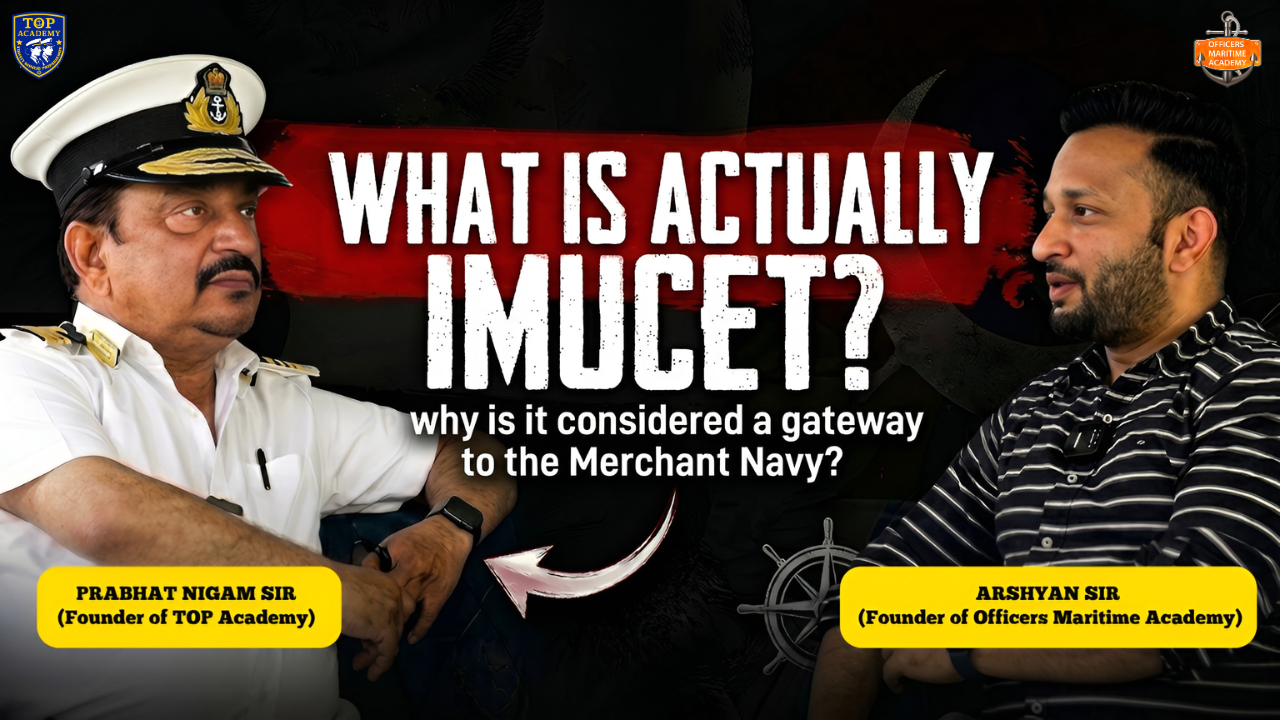
What is actually IMUCET ? Why is it Considered a gateway to the Merchant Navy
What is actually IMUCET ? Why is it Considered a gateway to the Merchant Navy? https://www.youtube.com/watch?v=l0N5xOQtCy0 Choosing a career in